
CASE STUDY: STL Street Lights
Transforming Urban Infrastructure with Custom Software-Defined Radio Technology
Learn how we developed a breakthrough wireless solution that made synchronized smart street lighting viable for dense urban environments.
STL Street Lights
Connected technology in a complex urban environment.
Services
Hardware Engineering, Firmware Development, Software Development
Project Timeline
7 months to FCC-approved deployment
Tech Stack
Custom SDR Hardware, XBee Form Factor, Low-Bandwidth RF Protocol, Application-Level API
The Challenge: From Proof of Concept to Consumer Ready
St. Louis City was on a mission to transform downtown with smart street lighting—a system that could change colors for Cardinals games (red), Blues games (blue), and create dynamic displays that would make the downtown area more engaging and vibrant. The vision was compelling, but the execution faced a fundamental technical problem.
The project required every street light to communicate reliably in real-time, staying perfectly synchronized across the entire downtown grid. Prior to engagement with Systematic, Labyrinth tried multiple off-the-shelf radio technologies to create the mesh network needed for this coordination. None of them worked.
The commercial solutions struggled with signal penetration through dense urban buildings. Connectivity dropped frequently. And the per-light installation cost for the hardware needed was astronomical—making the entire project economically unfeasible.
They needed a solution that could handle the realities of a dense urban environment while keeping costs reasonable enough to deploy at scale.
We partnered with Labyrinth Technologies to solve this challenge. Labyrinth provided the system architecture direction and handled the physical installation throughout downtown St. Louis. We developed the custom hardware, firmware, and the complete technology stack that would make synchronized street lighting technically and economically viable.

Define & Discovery
Understanding the Real Problem
We started by analyzing why standard wireless technologies were failing in this environment. The issue wasn’t just technical capability—it was the fundamental mismatch between what commercial RF protocols were designed for and what a synchronized street light network actually needed.
Standard protocols like Wi-Fi and cellular (3G/4G at the time) were built for high bandwidth applications. They couldn’t efficiently penetrate the dense urban landscape of downtown St. Louis. More critically, they were solving the wrong problem—street light control doesn’t need high bandwidth. It needs reliability, low latency for synchronization, and resilient mesh networking in challenging RF environments.
Key Requirements Identified
- Reliable communication through dense urban infrastructure
- Synchronized control across hundreds of lights
- Low per-unit hardware cost for economic viability
- Simple command structure for color changes and status monitoring
- Build in a standardized form factor so it could be used with off the shelf hardware if needed

Architect & Design
Building a Custom RF Solution from the Ground Up
Rather than trying to force-fit existing technology, we designed a custom software-defined radio (SDR) solution optimized specifically for this use case.
Design Decisions:
- Low-bandwidth protocol: Since street lights only needed to receive simple commands (color changes, status requests), we engineered an ultra-efficient protocol that transmitted only essential data
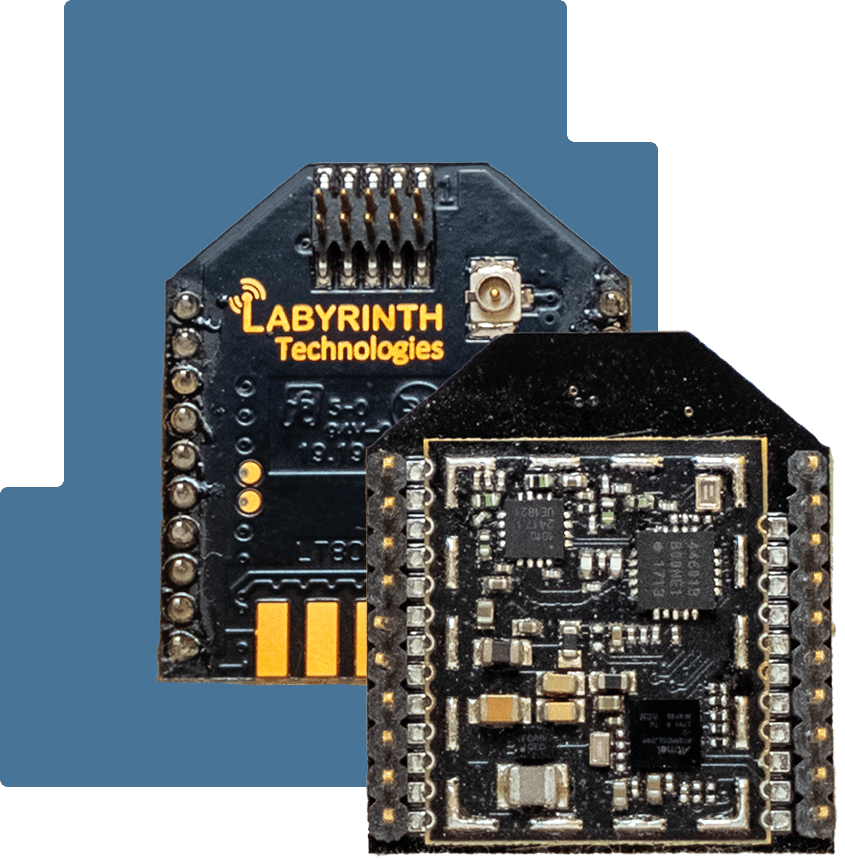
- XBee form factor compatibility: We designed our custom hardware to match the standardized XBee form factor and pinout, making it a drop-in replacement that worked with Labyrinth’s existing infrastructure
- Custom RF protocol: We controlled the low-level RF transmission in ways that hadn’t been done before for urban mesh networks, optimizing for signal penetration and reliability
- Application-level API: We abstracted the complexity, giving Labyrinth simple AT style commands without requiring them to understand the underlying RF details
Why Software-Defined Radio?
Unlike standard wireless protocols, SDR gives complete control over how radio frequencies move between devices. This allowed us to dial in the perfect parameters for downtown St. Louis—optimizing for building penetration, interference resistance, and mesh network reliability in ways that standardized protocols couldn’t match.
At the time (around 2019), this approach was unconventional. Today, software-defined radio is used extensively in:
- Military and law enforcement communication systems
- Wireless video transmission for broadcasting
- Specialized IoT deployments requiring custom RF characteristics
- Applications requiring interference resistance and signal security

Develop & Iterate
From Concept to FCC-Compliant Hardware
We moved rapidly through development, building and validating both the custom hardware and the RF protocol. The development included:
- Custom PCB design in the XBee form factor
- Low-level RF protocol implementation and optimization
- Application-level command protocol for client control
- Extensive field testing in urban environments
- FCC compliance lab work and certification
The entire project—from initial design through FCC certification—took just 7 months. This timeline included all regulatory compliance work, which typically extends project schedules significantly.

Deploy & Optimize
Delivering 85-90% Cost Savings
The results validated the custom approach. Our solution delivered:
- Dramatic cost reduction: Per-light installation costs came in at 25% of what off-the-shelf hardware would have required—an 75% cost savings
- Reliable mesh networking: The custom RF protocol provided consistent connectivity throughout downtown, even through dense urban infrastructure
- Simplified deployment: The XBee form factor compatibility meant straightforward installation
- Scalable foundation: The low-bandwidth, resilient design created a platform for future expansion
The lights were deployed throughout downtown St. Louis, transforming the urban landscape with synchronized lighting that could adapt for events, games, and city celebrations.